sakibnsblog: DYING UNDER A PINK SUN: A SHORT STORY And then Old Nash decided to die next morning when the first ray of peculiar pink sunlight will hit the top of...
A SHORT STORY And then Old Nash decided to die next morning when the first ray of peculiar pink sunlight will hit the top of the sharp boulder not too far from the dome. He is sitting in observatory desk at the top floor of the dome. The room is dark, merely illuminated with the instrument panel's light. The windows are built to restrict the sunlight to come in, though no problem to watch out. He is sitting in front of one window panel from where he could see the sun is setting in the distant horizon. Planet surface is floating by the peculiar, eerie pink twilight creating a kind of weird feelings in the observer's mind. Old Nash, age 777 years, a legendary galactic explorer, and based on the galactic standard, he is old now. He had explored so many worlds, walked on the surface of so many planets, bathed under so many stars of the galaxy, he himself couldn't remember. For the Last few years he had been on some important exploration in this part of the g...
THE SIGNAL BY: NAZMUS SAKIB No Way! Jeromme exclaimed in utter disbelief. How come the ship's computer receives a signal in this remote part of the galaxy and yet the computer is unable to decipher it! Jeromme left the base station two months ago. It was too easy to convince the officer at the base station of planet Auriora that he intended to explore the planets those are listed in the official galactic map. There are hundreds of them and there are also thousands of uncharted regions and planets in this part of galaxy. He was about set his direction towards a particular region of space but he could not mention that to the officer. There are many reasons and most important reason of those is that nobody is allowed to travel or explore uncharted region of space unless he has a valid authenticity which he don't have. For about fifteen days, he was wondering within the charted region, landed on some planets. He was just trying to showing off...
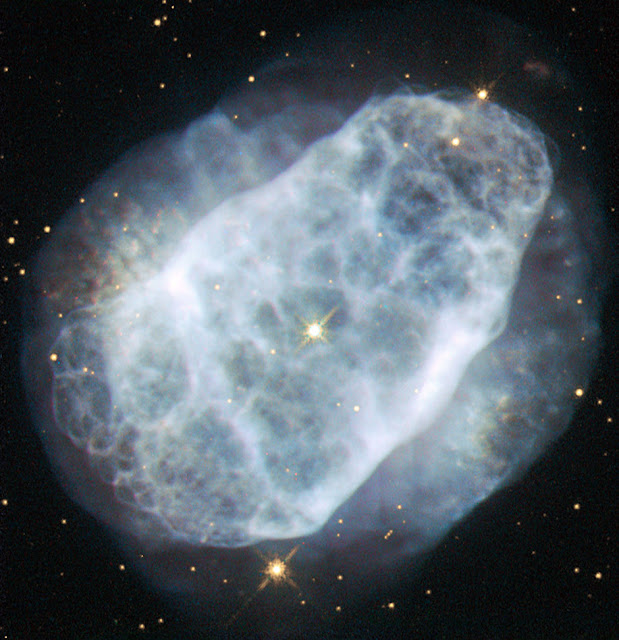
COPIED FROM: Hubble views a nitrogen-rich planetary nebula NGC 6153 is a planetary nebula that is elliptical in shape, with an extremely rich network of loops and filaments, shown clearly in this Hubble image. However, this is not what makes this planetary nebula so interesting for astronomers — it contains five times more nitrogen than our Sun as well as high concentrations of other elements. Image credit: ESA/Hubble & NASA, Acknowledgement: Matej Novak. This NASA/ESA Hubble Space Telescope image shows a planetary nebula named NGC 6153, located about 4,000 light-years away in the southern constellation of Scorpius (The Scorpion). The faint blue haze across the frame shows what remains of a star like the Sun after it has depleted most of its fuel. When this happens, the outer layers of the star are ejected, and get excited and ionised by the energetic ultraviolet light emitted by the bright hot core of the star, forming the nebula. NGC 6153 is a plane...


Comments
Post a Comment